Search This Blog

Nov 26, 2010

Ode To a Nightingale

" Ode To a Nightingale "


"Ode to a Nightingale" is a poem by John Keats written in May 1819 

"Summary"

My heart aches, and a drowsy numbness pains
My sense, as though of hemlock I had drunk,
Or emptied some dull opiate to the drains
One minute past, and Lethe-wards had sunk:
'Tis not through envy of thy happy lot,
But being too happy in thine happiness,--
That thou, light-winged Dryad of the trees
In some melodious plot
Of beechen green, and shadows numberless,
Singest of summer in full-throated ease.

 The speaker opens with a declaration of his own heartache. He feels numb, as though he had taken a drug only a moment ago. He is addressing a nightingale he hears singing somewhere in the forest and says that his “drowsy numbness” is not from envy of the nightingale’s happiness, but rather from sharing it too completely; he is “too happy” that the nightingale sings the music of summer from amid some unseen plot of green trees and shadows.


O, for a draught of vintage! that hath been
Cool'd a long age in the deep-delved earth,
Tasting of Flora and the country green,
Dance, and Provençal song, and sunburnt mirth!
O for a beaker full of the warm South,
Full of the true, the blushful Hippocrene,
With beaded bubbles winking at the brim,
And purple-stained mouth;
That I might drink, and leave the world unseen,
And with thee fade away into the forest dim:

In the second stanza, the speaker longs for the oblivion of alcohol, expressing his wish for wine, “a draught of vintage,” that would taste like the country and like peasant dances, and let him “leave the world unseen” and disappear into the dim forest with the nightingale.

Fade far away, dissolve, and quite forget
What thou among the leaves hast never known,
The weariness, the fever, and the fret
Here, where men sit and hear each other groan;
Where palsy shakes a few, sad, last gray hairs,
Where youth grows pale, and spectre-thin, and dies;
Where but to think is to be full of sorrow
And leaden-eyed despairs,
Where Beauty cannot keep her lustrous eyes,
Or new Love pine at them beyond to-morrow.

In the third stanza, he explains his desire to fade away, saying he would like to forget the troubles the nightingale has never known: “the weariness, the fever, and the fret” of human life, with its consciousness that everything is mortal and nothing lasts. Youth “grows pale, and spectre-thin, and dies,” and “beauty cannot keep her lustrous eyes.”


Away! away! for I will fly to thee,
Not charioted by Bacchus and his pards,
But on the viewless wings of Poesy,
Though the dull brain perplexes and retards:
Already with thee! tender is the night,
And haply the Queen-Moon is on her throne,
Cluster'd around by all her starry Fays;
But here there is no light,
Save what from heaven is with the breezes blown
Through verdurous glooms and winding mossy ways.

In the fourth stanza, the speaker tells the nightingale to fly away, and he will follow, not through alcohol (“Not charioted by Bacchus and his pards”), but through poetry, which will give him “viewless wings.” He says he is already with the nightingale and describes the forest glade, where even the moonlight is hidden by the trees, except the light that breaks through when the breezes blow the branches.

I cannot see what flowers are at my feet,
Nor what soft incense hangs upon the boughs,
But, in embalmed darkness, guess each sweet
Wherewith the seasonable month endows
The grass, the thicket, and the fruit-tree wild;
White hawthorn, and the pastoral eglantine;
Fast fading violets cover'd up in leaves;
And mid-May's eldest child,
The coming musk-rose, full of dewy wine,
The murmurous haunt of flies on summer eves.

In the fifth stanza, the speaker says that he cannot see the flowers in the glade, but can guess them “in embalmed darkness”: white hawthorne, eglantine, violets, and the musk-rose, “the murmurous haunt of flies on summer eves.” 

Darkling I listen; and, for many a time
I have been half in love with easeful Death,
Call'd him soft names in many a mused rhyme,
To take into the air my quiet breath;
Now more than ever seems it rich to die,
To cease upon the midnight with no pain,
While thou art pouring forth thy soul abroad
In such an ecstasy!
Still wouldst thou sing, and I have ears in vain--
To thy high requiem become a sod.

In the sixth stanza, the speaker listens in the dark to the nightingale, saying that he has often been “half in love” with the idea of dying and called Death soft names in many rhymes. Surrounded by the nightingale’s song, the speaker thinks that the idea of death seems richer than ever, and he longs to “cease upon the midnight with no pain” while the nightingale pours its soul ecstatically forth. If he were to die, the nightingale would continue to sing, he says, but he would “have ears in vain” and be no longer able to hear.


Thou wast not born for death, immortal Bird!
No hungry generations tread thee down;
The voice I hear this passing night was heard
In ancient days by emperor and clown:
Perhaps the self-same song that found a path
Through the sad heart of Ruth, when, sick for home,
She stood in tears amid the alien corn;
The same that oft-times hath
Charm'd magic casements, opening on the foam
Of perilous seas, in faery lands forlorn.

In the seventh stanza, the speaker tells the nightingale that it is immortal, that it was not “born for death.” He says that the voice he hears singing has always been heard, by ancient emperors and clowns, by homesick Ruth; he even says the song has often charmed open magic windows looking out over “the foam / Of perilous seas, in faery lands forlorn.”

Forlorn! the very word is like a bell
To toll me back from thee to my sole self!
Adieu! the fancy cannot cheat so well
As she is fam'd to do, deceiving elf.
Adieu! adieu! thy plaintive anthem fades
Past the near meadows, over the still stream,
Up the hill-side; and now 'tis buried deep
In the next valley-glades:
Was it a vision, or a waking dream?
Fled is that music:--Do I wake or sleep?

 In the eighth stanza, the word forlorn tolls like a bell to restore the speaker from his preoccupation with the nightingale and back into himself. As the nightingale flies farther away from him, he laments that his imagination has failed him and says that he can no longer recall whether the nightingale’s music was “a vision, or a waking dream.” Now that the music is gone, the speaker cannot recall whether he himself is awake or asleep.

"Form"

Like most of the other odes, “Ode to a Nightingale” is written in ten-line stanzas. However, unlike most of the other poems, it is metrically variable—though not so much as “Ode to Psyche.” The first seven and last two lines of each stanza are written in iambic pentameter; the eighth line of each stanza is written in trimeter, with only three accented syllables instead of five. “Nightingale” also differs from the other odes in that its rhyme scheme is the same in every stanza (every other ode varies the order of rhyme in the final three or four lines except “To Psyche,” which has the loosest structure of all the odes). Each stanza in “Nightingale” is rhymed ABABCDECDE, Keats’s most basic scheme throughout the odes.

"Themes"

With “Ode to a Nightingale,” Keats’s speaker begins his fullest and deepest exploration of the themes of creative expression and the mortality of human life. In this ode, the transience of life and the tragedy of old age (“where palsy shakes a few, sad, last gray hairs, / Where youth grows pale, and spectre-thin, and dies”) is set against the eternal renewal of the nightingale’s fluid music (“Thou wast not born for death, immortal bird!”). The speaker reprises the “drowsy numbness” he experienced in “Ode on Indolence,” but where in “Indolence” that numbness was a sign of disconnection from experience, in “Nightingale” it is a sign of too full a connection: “being too happy in thine happiness,” as the speaker tells the nightingale. Hearing the song of the nightingale, the speaker longs to flee the human world and join the bird. His first thought is to reach the bird’s state through alcohol—in the second stanza, he longs for a “draught of vintage” to transport him out of himself. But after his meditation in the third stanza on the transience of life, he rejects the idea of being “charioted by Bacchus and his pards” (Bacchus was the Roman god of wine and was supposed to have been carried by a chariot pulled by leopards) and chooses instead to embrace, for the first time since he refused to follow the figures in “Indolence,” “the viewless wings of Poesy.”

 The rapture of poetic inspiration matches the endless creative rapture of the nightingale’s music and lets the speaker, in stanzas five through seven, imagine himself with the bird in the darkened forest. The ecstatic music even encourages the speaker to embrace the idea of dying, of painlessly succumbing to death while enraptured by the nightingale’s music and never experiencing any further pain or disappointment. But when his meditation causes him to utter the word “forlorn,” he comes back to himself, recognizing his fancy for what it is—an imagined escape from the inescapable (“Adieu! the fancy cannot cheat so well / As she is fam’d to do, deceiving elf”). As the nightingale flies away, the intensity of the speaker’s experience has left him shaken, unable to remember whether he is awake or asleep.

In “Indolence,” the speaker rejected all artistic effort. In “Psyche,” he was willing to embrace the creative imagination, but only for its own internal pleasures. But in the nightingale’s song, he finds a form of outward expression that translates the work of the imagination into the outside world, and this is the discovery that compels him to embrace Poesy’s “viewless wings” at last. The “art” of the nightingale is endlessly changeable and renewable; it is music without record, existing only in a perpetual present. As befits his celebration of music, the speaker’s language, sensually rich though it is, serves to suppress the sense of sight in favor of the other senses. He can imagine the light of the moon, “But here there is no light”; he knows he is surrounded by flowers, but he “cannot see what flowers” are at his feet. This suppression will find its match in “Ode on a Grecian Urn,” which is in many ways a companion poem to “Ode to a Nightingale.” In the later poem, the speaker will finally confront a created art-object not subject to any of the limitations of time; in “Nightingale,” he has achieved creative expression and has placed his faith in it, but that expression—the nightingale’s song—is spontaneous and without physical manifestation.

The Rime of the Ancient Mariner

"The Rime of the Ancient Mariner"


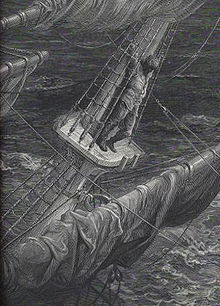
The Rime of the Ancient Mariner (originally The Rime of the Ancyent Marinere) is the longest major poem by the English poet Samuel Taylor Coleridge, written in 1797–98 and published in the first edition of Lyrical Ballads in 1798 

"Summary"

Three young men are walking together to a wedding, when one of them is detained by a grizzled old sailor. The young Wedding-Guest angrily demands that the Mariner let go of him, and the Mariner obeys. But the young man is transfixed by the ancient Mariner’s “glittering eye” and can do nothing but sit on a stone and listen to his strange tale. The Mariner says that he sailed on a ship out of his native harbor—”below the kirk, below the hill, / Below the lighthouse top”—and into a sunny and cheerful sea. Hearing bassoon music drifting from the direction of the wedding, the Wedding-Guest imagines that the bride has entered the hall, but he is still helpless to tear himself from the Mariner’s story. The Mariner recalls that the voyage quickly darkened, as a giant storm rose up in the sea and chased the ship southward. Quickly, the ship came to a frigid land “of mist and snow,” where “ice, mast-high, came floating by”; the ship was hemmed inside this maze of ice. But then the sailors encountered an Albatross, a great sea bird. As it flew around the ship, the ice cracked and split, and a wind from the south propelled the ship out of the frigid regions, into a foggy stretch of water. The Albatross followed behind it, a symbol of good luck to the sailors. A pained look crosses the Mariner’s face, and the Wedding-Guest asks him, “Why look’st thou so?” The Mariner confesses that he shot and killed the Albatross with his crossbow.

 At first, the other sailors were furious with the Mariner for having killed the bird that made the breezes blow. But when the fog lifted soon afterward, the sailors decided that the bird had actually brought not the breezes but the fog; they now congratulated the Mariner on his deed. The wind pushed the ship into a silent sea where the sailors were quickly stranded; the winds died down, and the ship was “As idle as a painted ship / Upon a painted ocean.” The ocean thickened, and the men had no water to drink; as if the sea were rotting, slimy creatures crawled out of it and walked across the surface. At night, the water burned green, blue, and white with death fire. Some of the sailors dreamed that a spirit, nine fathoms deep, followed them beneath the ship from the land of mist and snow. The sailors blamed the Mariner for their plight and hung the corpse of the Albatross around his neck like a cross.

A weary time passed; the sailors became so parched, their mouths so dry, that they were unable to speak. But one day, gazing westward, the Mariner saw a tiny speck on the horizon. It resolved into a ship, moving toward them. Too dry-mouthed to speak out and inform the other sailors, the Mariner bit down on his arm; sucking the blood, he was able to moisten his tongue enough to cry out, “A sail! a sail!” The sailors smiled, believing they were saved. But as the ship neared, they saw that it was a ghostly, skeletal hull of a ship and that its crew included two figures: Death and the Night-mare Life-in-Death, who takes the form of a pale woman with golden locks and red lips, and “thicks man’s blood with cold.” Death and Life-in-Death began to throw dice, and the woman won, whereupon she whistled three times, causing the sun to sink to the horizon, the stars to instantly emerge. As the moon rose, chased by a single star, the sailors dropped dead one by one—all except the Mariner, whom each sailor cursed “with his eye” before dying. The souls of the dead men leapt from their bodies and rushed by the Mariner.

The Wedding-Guest declares that he fears the Mariner, with his glittering eye and his skinny hand. The Mariner reassures the Wedding-Guest that there is no need for dread; he was not among the men who died, and he is a living man, not a ghost. Alone on the ship, surrounded by two hundred corpses, the Mariner was surrounded by the slimy sea and the slimy creatures that crawled across its surface. He tried to pray but was deterred by a “wicked whisper” that made his heart “as dry as dust.” He closed his eyes, unable to bear the sight of the dead men, each of who glared at him with the malice of their final curse. For seven days and seven nights the Mariner endured the sight, and yet he was unable to die. At last the moon rose, casting the great shadow of the ship across the waters; where the ship’s shadow touched the waters, they burned red. The great water snakes moved through the silvery moonlight, glittering; blue, green, and black, the snakes coiled and swam and became beautiful in the Mariner’s eyes. He blessed the beautiful creatures in his heart; at that moment, he found himself able to pray, and the corpse of the Albatross fell from his neck, sinking “like lead into the sea.”

"Form"

“The Rime of the Ancient Mariner” is written in loose, short ballad stanzas usually either four or six lines long but, occasionally, as many as nine lines long. The meter is also somewhat loose, but odd lines are generally tetrameter, while even lines are generally trimeter. (There are exceptions: In a five-line stanza, for instance, lines one, three, and four are likely to have four accented syllables—tetrameter—while lines two and five have three accented syllables.) The rhymes generally alternate in an ABAB or ABABAB scheme, though again there are many exceptions; the nine-line stanza in Part III, for instance, rhymes AABCCBDDB. Many stanzas include couplets in this way—five-line stanzas, for example, are rhymed ABCCB, often with an internal rhyme in the first line, or ABAAB, without the internal rhyme.

"Commentary"

“The Rime of the Ancient Mariner” is unique among Coleridge’s important works— unique in its intentionally archaic language (“Eftsoons his hand drops he”), its length, its bizarre moral narrative, its strange scholarly notes printed in small type in the margins, its thematic ambiguity, and the long Latin epigraph that begins it, concerning the multitude of unclassifiable “invisible creatures” that inhabit the world. Its peculiarities make it quite atypical of its era; it has little in common with other Romantic works. Rather, the scholarly notes, the epigraph, and the archaic language combine to produce the impression (intended by Coleridge, no doubt) that the “Rime” is a ballad of ancient times (like “Sir Patrick Spence,” which appears in “Dejection: An Ode”), reprinted with explanatory notes for a new audience.

But the explanatory notes complicate, rather than clarify, the poem as a whole; while there are times that they explain some unarticulated action, there are also times that they interpret the material of the poem in a way that seems at odds with, or irrelevant to, the poem itself. For instance, in Part II, we find a note regarding the spirit that followed the ship nine fathoms deep: “one of the invisible inhabitants of this planet, neither departed souls nor angels; concerning whom the learned Jew, Josephus, and the Platonic Constantinopolitan, Michael Psellus, may be consulted.” What might Coleridge mean by introducing such figures as “the Platonic Constantinopolitan, Michael Psellus,” into the poem, as marginalia, and by implying that the verse itself should be interpreted through him?

This is a question that has puzzled scholars since the first publication of the poem in this form. (Interestingly, the original version of the “Rime,” in the 1797 edition of Lyrical Ballads, did not include the side notes.) There is certainly an element of humor in Coleridge’s scholarly glosses—a bit of parody aimed at the writers of serious glosses of this type; such phrases as “Platonic Constantinopolitan” seem consciously silly. It can be argued that the glosses are simply an amusing irrelevancy designed to make the poem seem archaic and that the truly important text is the poem itself—in its complicated, often Christian symbolism, in its moral lesson (that “all creatures great and small” were created by God and should be loved, from the Albatross to the slimy snakes in the rotting ocean) and in its characters.

If one accepts this argument, one is faced with the task of discovering the key to Coleridge’s symbolism: what does the Albatross represent, what do the spirits represent, and so forth. Critics have made many ingenious attempts to do just that and have found in the “Rime” a number of interesting readings, ranging from Christian parable to political allegory. But these interpretations are dampened by the fact that none of them (with the possible exception of the Christian reading, much of which is certainly intended by the poem) seems essential to the story itself. One can accept these interpretations of the poem only if one disregards the glosses almost completely.

A more interesting, though still questionable, reading of the poem maintains that Coleridge intended it as a commentary on the ways in which people interpret the lessons of the past and the ways in which the past is, to a large extent, simply unknowable. By filling his archaic ballad with elaborate symbolism that cannot be deciphered in any single, definitive way and then framing that symbolism with side notes that pick at it and offer a highly theoretical spiritual-scientific interpretation of its classifications, Coleridge creates tension between the ambiguous poem and the unambiguous-but-ridiculous notes, exposing a gulf between the “old” poem and the “new” attempt to understand it. The message would be that, though certain moral lessons from the past are still comprehensible—”he liveth best who loveth best” is not hard to understand— other aspects of its narratives are less easily grasped.

In any event, this first segment of the poem takes the Mariner through the worst of his trials and shows, in action, the lesson that will be explicitly articulated in the second segment. The Mariner kills the Albatross in bad faith, subjecting himself to the hostility of the forces that govern the universe (the very un-Christian-seeming spirit beneath the sea and the horrible Life-in-Death). It is unclear how these forces are meant to relate to one another—whether the Life-in-Death is in league with the submerged spirit or whether their simultaneous appearance is simply a coincidence.

After earning his curse, the Mariner is able to gain access to the favor of God—able to regain his ability to pray—only by realizing that the monsters around him are beautiful in God’s eyes and that he should love them as he should have loved the Albatross. In the final three books of the poem, the Mariner’s encounter with a Hermit will spell out this message explicitly, and the reader will learn why the Mariner has stopped the Wedding-Guest to tell him this story.

Oct 18, 2010

The Tables Turned

"The Tables Turned"

The speaker begins by telling his friend to stop reading books; he'll become fat from being sedentary. The speaker then asks why he chooses to be so serious while outside there is a beautiful evening scene:

Up! up! my Friend, and quit your books;

Or surely you'll grow double:

Up! up! my friend, and clear your looks,

Why all this toil and trouble?


The sun above the mountain's head,

A freshening lustre mellow

Through all the long green fields has spread,

His first sweet evening yellow.


The speaker continues, telling his friend that books are dull and tedious. Rather than reading, he should venture outside to where the linnet (a small finch) and the throstle (a song bird) are singing beautiful music containing more wisdom than any book. The two lines that follow (15 and 16) are probably the most important in the poem: "Come forth into the light of things, / Let Nature be your teacher." The speaker is telling his friend that Nature has more to teach than books, and that he should go outside rather than seek refuge in dry pages:

Books! 'tis a dull and endless strife:

Come, hear the woodland linnet,

How sweet his music! on my life,

There's more of wisdom in it.


And hark! how blithe the throstle sings!

He, too, is no mean preacher:

Come forth into the light of things,

Let Nature be your teacher.

In the next two stanzas the speaker tells his friend that Mother Nature is full of wealth, and that she is ready to bestow her fruits on our minds and hearts. He also says that in nature wisdom comes from being happy and healthy, and that a person can learn more about humanity and about good and evil from a tree than from a sage:

She has a world of ready wealth,

Our minds and hearts to bless--

Spontaneous wisdom breathed by health,

Truth breathed by cheerfulness.


One impulse from a vernal wood

May teach you more of man,

Of moral evil and of good,

Than all the sages can.


The speaker suggests that even though nature brings humanity sweet traditions of intelligence, we tend to ruin that knowledge by dissecting it. Instead, we should reject traditional science and art and simply come into nature ready to learn with "a heart / That watches and receives":

Sweet is the lore which Nature brings;

Our meddling intellect

Mis-shapes the beauteous forms of things:--

We murder to dissect.


Enough of Science and of Art;

Close up those barren leaves;

Come forth, and bring with you a heart

That watches and receives.

Analysis:

"The Tables Turned" consists of eight four-line stanzas in interlocking rhymes (abab). It is in ballad form, written in iambs with four beats in the first and third lines of each stanza, and three beats in the second and fourth lines.

It certainly seems strange to find a poet telling his friend (and through his friend his readers) to stop reading, and yet much of what Wordsworth is saying in "The Tables Turned" fits perfectly with the Romantic Movement, which emphasizes the importance of being a part of nature. For Wordsworth there is much more to be learned by watching, listening to, and simply taking in one's surroundings than by studying books. At the same time, there is a strong element of irony at play here. First of all, Wordsworth is making these statements in a poem, which will become (as he knew it would) a part of a book meant to be read. Even though he believes that nature is a great teacher, he is not ready to throw away books altogether.

It is important to note the poem's title: "The Tables Turned." The title leads us to believe that Wordsworth is reacting to the status quo, or to the way that people usually think, which in this case is that books are the best way to learn. In order to make the strongest statement possible, Wordsworth goes to the opposite extreme, even though his true feelings probably lie somewhere in the middle.

The Solitary Reaper

"The Solitary Reaper"


1- In the first stanza the speaker comes across a beautiful girl working alone in the fields of Scotland (the Highland). She is "Reaping and singing by herself." He tells the reader not to interrupt her, and then mentions that the valley is full of song.
Behold her, single in the field,


Yon solitary Highland Lass!

Reaping and singing by herself;

Stop here, or gently pass!

Alone she cuts and binds the grain,

And sings a melancholy strain;

O listen! for the Vale profound

Is overflowing with the sound.


2- The second stanza is a list of things that cannot equal the beauty of the girl's singing:

No Nightingale did ever chaunt


More welcome notes to weary bands

Of travellers in some shady haunt,

Among Arabian sands:

A voice so thrilling ne'er was heard

In spring-time from the Cuckoo-bird,

Breaking the silence of the seas

Among the farthest Hebrides.

3- In the third stanza the reader learns that the speaker cannot understand the words being sung. He can only guess at what she might be singing about:

Will no one tell me what she sings?--


Perhaps the plaintive numbers flow

For old, unhappy, far-off things,

And battles long ago:

Or is it some more humble lay,

Familiar matter of to-day?

Some natural sorrow, loss, or pain,

That has been, and may be again?


4- In the fourth and final stanza the speaker tells the reader that even though he did not know what she was singing about, the music stayed in his heart as he continued up the hill:

Whate'er the theme, the Maiden sang


As if her song could have no ending;

I saw her singing at her work,

And o'er the sickle bending;--

I listened, motionless and still;

And, as I mounted up the hill

The music in my heart I bore,

Long after it was heard no more.

Analysis:

"The Solitary Reaper" was written on November 5, 1805 and published in 1807. The poem is broken into four eight-line stanzas (32 lines total). Most of the poem is in iambic tetrameter. The rhyme scheme for the stanzas is either abcbddee or ababccdd. (In the first and last stanzas the first and third lines don't rhyme, while in the other two stanzas they do.)

This poem is unique in Wordsworth's oeuvre because while most of his work is based closely on his own experiences, "The Solitary Reaper" is based on the experience of someone else: Thomas Wilkinson, as described in his Tours to the British Mountains. The passage that inspired Wordsworth is the following: "Passed a female who was reaping alone: she sung in Erse [the Gaelic language of Scotland] as she bended over her sickle; the sweetest human voice I ever heard: her strains were tenderly melancholy, and felt delicious, long after they were heard no more" (as qtd. in The Norton Anthology English Literature).

Part of what makes this poem so intriguing is the fact that the speaker does not understand the words being sung by the beautiful young lady. In the third stanza, he is forced to imagine what she might be singing about. He supposes that she may be singing about history and things that happened long ago, or some sadness that has happened in her own time and will happen again.

As the speaker moves on, he carries the music of the young lady with him in his heart. This is a prevalent theme in much of Wordsworth's poetry. For instance, the same idea is used in "I wandered lonely as a cloud" when the speaker takes the memory of the field of daffodils with him to cheer him up on bad days.

William Wordsworth

"William Wordsworth Biography"


William Wordsworth (1770-1850), British poet, credited with ushering in the English Romantic Movement with the publication of Lyrical Ballads (1798) in collaboration with Samuel Taylor Coleridge.


William Wordsworth was born on 7 April 1770 in Cockermouth, Cumberland, in the Lake District. His father was John Wordsworth, Sir James Lowther's attorney. The magnificent landscape deeply affected Wordsworth's imagination and gave him a love of nature. He lost his mother when he was eight and five years later his father. The domestic problems separated Wordsworth from his beloved and neurotic sister Dorothy, who was a very important person in his life.


With the help of his two uncles, Wordsworth entered a local school and continued his studies at Cambridge University. Wordsworth made his debut as a writer in 1787, when he published a sonnet in The European Magazine. In that same year he entered St. John's College, Cambridge, from where he took his B.A. in 1791.


During a summer vacation in 1790 Wordsworth went on a walking tour through revolutionary France and also traveled in Switzerland. On his second journey in France, Wordsworth had an affair with a French girl, Annette Vallon, a daughter of a barber-surgeon, by whom he had an illegitimate daughter Anne Caroline. The affair was basis of the poem "Vaudracour and Julia", but otherwise Wordsworth did his best to hide the affair from posterity.


In 1795 he met Coleridge. Wordsworth's financial situation became better in 1795 when he received a legacy and was able to settle at Racedown, Dorset, with his sister Dorothy.
Encouraged by Coleridge and stimulated by the close contact with nature, Wordsworth composed his first masterwork, Lyrical Ballads, which opened with Coleridge's "Ancient Mariner." About 1798 he started to write a large and philosophical autobiographical poem, completed in 1805, and published posthumously in 1850 under the title The Prelude.


Wordsworth spent the winter of 1798-99 with his sister and Coleridge in Germany, where he wrote several poems, including the enigmatic 'Lucy' poems. After return he moved Dove Cottage, Grasmere, and in 1802 married Mary Hutchinson. They cared for Wordsworth's sister Dorothy for the last 20 years of her life.


Wordsworth's second verse collection, Poems, In Two Volumes, appeared in 1807. Wordsworth's central works were produced between 1797 and 1808. His poems written during middle and late years have not gained similar critical approval. Wordsworth's Grasmere period ended in 1813. He was appointed official distributor of stamps for Westmoreland. He moved to Rydal Mount, Ambleside, where he spent the rest of his life. In later life Wordsworth abandoned his radical ideas and became a patriotic, conservative public man.


In 1843 he succeeded Robert Southey (1774-1843) as England's poet laureate. Wordsworth died on April 23, 1850.

Oct 17, 2010

Romanticism

"The Romantic Movement" 

The Romantic movement in literature began around the end of the 18th century in Western Europe and flourished in the first half of the 19th century. It was in part a rebellion against the Enlightenment of the previous century and its focus on scientific and rational thought. Romantic literature is characterized by an emphasis on emotion, passion, and the natural world. Nationalism was an important factor in the Romantic movement, and many authors turned to folk tales and native mythologies as source material. A return to the aesthetics and ethos of the medieval period also featured strongly in the Romantic sensibility. 


Some of the earliest examples of Romantic literature emerged in Germany, where the most important literary figure of the period was Johann Wolfgang von Goethe. His first novel, The Sorrows of Young Werther (1774), about a young, sensitive artist, was popular throughout Europe. Goethe also used myth and local folklore as subjects for his poetry and helped inspire a sense of German nationalism in the decades before a unified Germany. The American and French Revolutions in the late 18th century added to the popularity of such romantic ideals as freedom, liberty, and national pride.
 
Romanticism dominated English literature throughout the 19th century. Romantic poetry, in particular, is among the most important work of the period. Notable Romantic poets from Britain include William Wordsworth, Samuel Taylor Coleridge, William Blake, Lord Byron, Percy Bysshe Shelley, and John Keats. Common themes in their work include religious fervor, nature, Ancient Greek aesthetics, and emotional response to beauty. Romantic novels were also popular in 19th century Britain, often in the form of the Gothic novel, which exploited such emotions as fear and romantic love. Some well-known examples are Mary Shelley's Frankenstein (1818), Emily Bronte's Wuthering Heights (1847), and Charlotte Bronte's Jane Eyre (1847).
 
Romantic literature also flourished in the young United States. Much of it was also in the Gothic vein, such as the work of Edgar Allen Poe, Washington Irving, and Nathaniel Hawthorne. Transcendentalists like Henry David Thoreau and Ralph Waldo Emerson stressed the beauty of nature and man's identity as a natural being, themes echoed in the later work of poet Walt Whitman. James Fennimore Cooper focused on the nationalist aspect of Romanticism with his tales of the American frontier and Native Americans.

Romanticism also influenced the literature of other countries, although not as extensively as those discussed above. In France, the novels of Victor Hugo and Stendhal showed some Romantic influence, but they are more often characterized as part of the Realist movement. In Eastern Europe, Russian writers Alexander Pushkin and Mikhail Lermontov, as well as Polish poet Adam Mickiewicz, were among the practitioners of the Romantic movement.
 

الهدف من إنشاء المدونه

تم انشاء المدونه لطلاب ثالثه انجليزى اساسى (بكليه التربيه جامعة عين شمس) حتى نساعد بعضنا على الدراسه، وايضاً لتطوير مهارات التعليم لدينا وكذلك مهارات اللغه.